Arlington, Va. – – September 20, 2026 -- Info-Tech Research Group has released a new blueprint warning that AI agents embedded in product workflows are making decisions without explicit human authorization, creating governance blind spots for IT organizations shifting to product-centric delivery models.
Silent delegation lets AI agents make product decisions unchecked
The research firm's "Make the Case for Product Delivery" blueprint identifies a phenomenon it calls silent delegation, where AI agents participating in discovery, prioritization, experimentation, delivery, and support can execute decisions without a documented human approval trail. Info-Tech says leaders often lack visibility into where agents are merely recommending actions versus actively executing them, leaving open questions about who can override an agent's decision and who remains accountable for the outcome.
Research fellow says clear ownership is now critical to agent oversight
"Projects deliver change. Product ownership sustains the value," said Hans Eckman, research fellow at Info-Tech Research Group. "In today's agent-enabled environments, clear ownership is even more critical. Teams need to know what an agent is authorized to do, when a human needs to approve or intervene, and who remains accountable for the result."
Blueprint outlines five-step framework covering agent classification and accountability
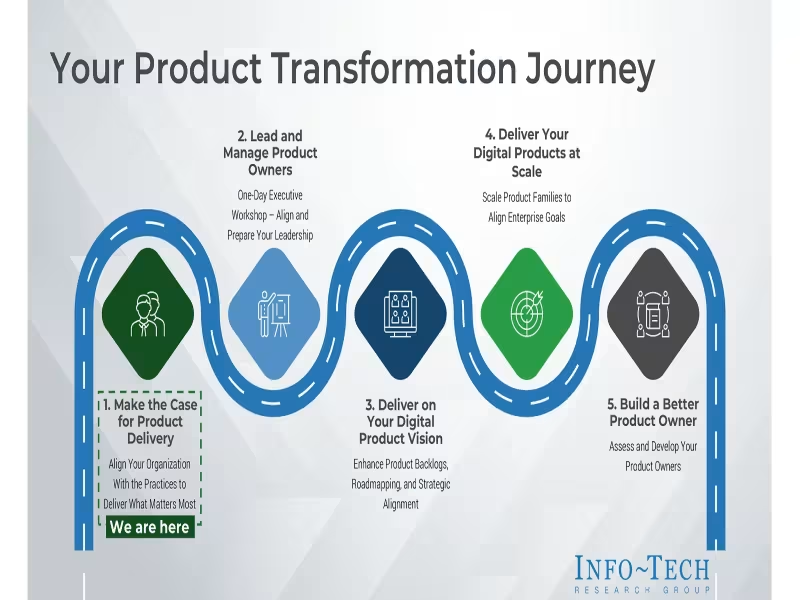
The blueprint guides product owners, product managers, development team leads, portfolio managers, and business analysts through five steps: defining product and distinguishing it from project delivery; defining drivers and goals for the transition, including explicit governance targets for AI-influenced decisions; mapping where AI tools and agents make recommendations or execute across workflows; building a now-next-later roadmap sequencing agent governance actions; and translating findings into a stakeholder-ready proposal involving data owners, platform teams, and AI/ML teams.
Agent classification carries distinct accountability implications, firm says
Info-Tech notes that leaders must determine whether an AI agent functions as part of a product, a product itself, or merely a delivery mechanism, since each classification triggers different accountability requirements. The firm argues that projects can continue funding and implementing specific changes, but only continuous product ownership preserves direction, prioritization, and accountability as products evolve — a structure increasingly tested by agents acting autonomously within delivery pipelines.
Blueprint delivers a Human-Agent Decision Map as a practical output
The resource package includes a supporting workbook, a presentation template, and a Human-Agent Decision Map designed to surface gaps in agent decision governance and build a practical case for stakeholders to approve the shift to product-centric delivery.