Market Analysis

Data Provider Pushes Intent Over Demographics in Warranty Mailings

Image
Data Provider Pushes Intent Over Demographics in Warranty Mailings

United States – October 28, 2026 -- A data provider serving warranty brands argues that behavioral intent, not demographic profiles such as women aged 35–55 with household income above $100,000, should drive audience selection for home and auto protection plan direct mail.

Provider says generative AI audience tools duplicate existing customers

The provider characterizes the industry's move toward generative AI as a race to cut costs. It claims automated selection tools often default to "lookalike" audiences that have already been tapped, so brands pay a premium to reach customers they already have. Its own approach keeps AI in support of data scientists rather than replacing them.
Nonprofits Shift From Donor Acquisition to Lifetime Value

Image
Nonprofits Shift From Donor Acquisition to Lifetime Value

United States – – October 27, 2026 -- Nonprofits are moving investment away from maximizing donor acquisition and toward maximizing donor lifetime value, according to a summary of seven macro-trends presented at The Bridge Conference.

Shrinking donor files push spending toward retention and sustainer programs

Donor files continue to shrink. Organizations are putting more money into retention, second-gift conversion, sustainer programs and lifetime value. Rebuilding the pipeline of everyday donors is essential to sustain future mid-level, major and planned giving programs.

First-party data and predictive modeling replace volume-driven testing

Organizations are investing more in first-party data, predictive modeling, segmentation and audience intelligence. Testing is turning more strategic, with fewer experiments aimed at understanding donor behavior.

TDengine Defines Industrial AI as Human-Reviewed Decision Support

Image
TDengine Defines Industrial AI as Human-Reviewed Decision Support

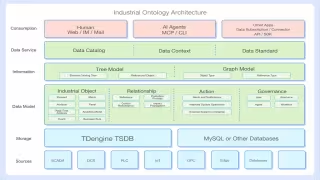
Global – October 27, 2026 -- TDengine is framing Industrial AI as decision support built on three layers (data, context and analysis) rather than as autonomous plant control, with accountability remaining with engineers and operators.

Industrial AI applies standard methods to physical operations

The approach uses machine learning, computer vision and generative AI on data from equipment, sensors, control systems, operational records and engineering documents. What makes an application industrial is the work it supports: pumps, compressors, production lines, energy systems and material flows. Enterprise AI, by contrast, mostly handles digital workflows such as drafting documents or summarizing meetings.

Healthcare's 3.2M Worker Gap Pushes Agentic AI Beyond Per-Seat SaaS

Image
Healthcare's 3.2M Worker Gap Pushes Agentic AI Beyond Per-Seat SaaS

United States – October 27, 2026 -- Healthcare faces a projected shortage of up to 3.2 million workers by 2026, and IntelePeer argues that gap is making per-seat enterprise software economically obsolete as buyers shift from purchasing tools to purchasing completed work.

Per-seat pricing fails when healthcare cannot fill the seats

Enterprise software has been priced per seat, per user, per license for two decades, on the assumption that the human is the engine and software makes that engine faster. The IntelePeer analysis says that assumption breaks where labor is the bottleneck. Administrative roles are among the hardest to fill and retain, according to the Mercer / Oliver Wyman projection it cites, and wage inflation is compressing margins.

Only 6% of Firms Scale AI; Healthcare Pilots Stall on Architecture

Image
Only 6% of Firms Scale AI; Healthcare Pilots Stall on Architecture

GLOBAL – October 27, 2026 -- Only about 6% of organizations have scaled AI to meaningful financial impact, leaving 94% stuck between experimentation and abandonment, according to McKinsey's 2024 State of AI survey cited by IntelePeer in a new healthcare analysis.

The vendor calls the gap "Pilot Purgatory": an AI voice agent handles a scheduling demo flawlessly, a pilot is approved, and within six months it is shelved. IntelePeer argues the fix is architecture rather than a better algorithm.

Human review of every AI action turns automation into overhead

Greater AI autonomy demands more evidence of safe, predictable behavior, a tension IntelePeer labels the Trust Paradox. It is most acute in regulated healthcare, where wrong actions can be non-compliant or financially damaging. Requiring a human to audit every output creates what the company calls "digital overhead", a costlier version of the existing process.

Full-Coverage QM Targets the 97% of CX Interactions Left Unseen

Image
Full-Coverage QM Targets the 97% of CX Interactions Left Unseen

Global – October 27, 2026 -- Organizations that review only 2–5% of customer interactions leave 95–97% unexamined. Some adopters of full-coverage quality management (QM) report a 30% uptick in conversion-related outcomes after closing the process gaps it exposed.

Sampling leaves systemic failures undetected

A 3–5% sample covers a handful of calls, reviewed by a handful of supervisors and scored with a handful of opinions. It misses agents who skip a critical verification step and AI agents that cannot recognize "yes, please" as a yes. It also misses routing flows that send the wrong caller type into the wrong experience, until hundreds of calls have transferred unnecessarily to a live queue.

Port of NEOM bulk calls jump to 25 as war diverts Red Sea cargo

Image
Port of NEOM bulk calls jump to 25 as war diverts Red Sea cargo

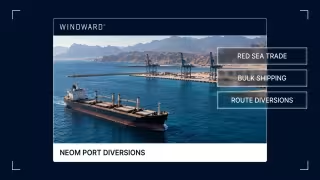
NEOM – October 27, 2026 -- Monthly RoRo vessel calls at the Port of NEOM reached 30 in September 2026, about 70% above the pre-war average of 17. War-diverted cargo is lifting traffic at a port built for a megacity that is shrinking, according to Windward maritime analysis.

The growth runs against NEOM's own trajectory. The Public Investment Fund wrote down its giga-projects by $8 billion at the end of 2024 and ordered spending cuts of more than 20%. The Line was paused in September 2025, and the $2.5 billion NEOM Stadium planned for the 2034 World Cup was shelved in early October 2026.

Gulf VLCC Rates Top $1.3M a Day as Tanker Attacks Spread

Image
Gulf VLCC Rates Top $1.3M a Day as Tanker Attacks Spread

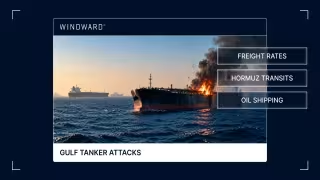
Qatar – October 27, 2026 -- The benchmark VLCC rate from Saudi Arabia to China has passed $1.3 million per day, pushing freight above 25-30% of the cost of Gulf crude versus 1-3% in normal market conditions, according to Windward. The surge follows a tanker strike off Qatar on October 7.

Tanker struck 51 nautical miles off Qatar breaks the Hormuz-only attack pattern

An unnamed tanker was hit by multiple projectiles 51 nautical miles off Madinat ash Shamal, UK Maritime Trade Operations (UKMTO) reported on October 7. It is the first attack outside the Strait of Hormuz since September 9, when a Greek-owned very large crude carrier was struck in Iraqi waters.

UKMTO has logged 16 attacks on ships in the Middle East Gulf in 10 days. Windward confirmed 12 of the vessels, 11 of them tankers. All were transiting dark through the U.S. military-assisted southern corridor.

Sanctioned Tankers Carry 55% of Russia's September Oil Exports

Image
Sanctioned Tankers Carry 55% of Russia's September Oil Exports

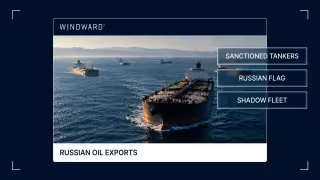
Russia – October 27, 2026 -- Sanctioned vessels carried 78 million barrels, or 55% of Russia's September oil exports, and 63% of its crude, as EU-owned tankers retreated from exposed routes, according to Windward analysis using Vortexa data.

Russia shipped 142.7 million barrels of crude and oil products in September. Crude accounted for 110.4 million barrels, about 3.7 million barrels per day and broadly level with August's 3.78 million bpd as reported by the IEA. Clean petroleum products totaled 14.9 million barrels, mostly naphtha (9.8 million), alongside 17.4 million barrels of fuel oil and feedstocks.

Windward: Dark Fleet Gaps Demand Shared All-Source Maritime Picture

Image
Windward: Dark Fleet Gaps Demand Shared All-Source Maritime Picture

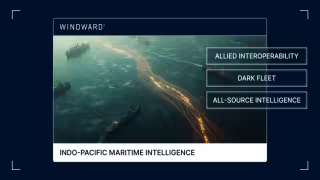
Indo-Pacific – – October 27, 2026 -- Russia reflagged 84 dark fleet tankers to its own registry in Q3 2026, more than four times the Q2 figure, according to Windward's Q3 2026 Maritime Risk Report. The maritime intelligence provider argues that allied navies and coast guards cannot counter such activity while each partner works from a separate slice of the picture.

Russia now flags 223 tankers, 18% of the total

One in three Aframax tankers worldwide now sits in the dark fleet, per the report. These vessels cross theaters routinely. Iranian crude loaded in the Gulf is commonly transferred ship to ship off Malaysia's Johor coast, roughly halfway between Iran and China, which buys about 90% of Iranian oil. One cargo can pass through CENTCOM and INDOPACOM and several national jurisdictions before discharge, and no single partner sees the whole route.